

Bond Proposal FAQs

Bond Basics
What is a bond proposal?
A bond is the primary way Michigan public school districts fund facility and infrastructure projects by asking local voters to authorize borrowing funds through a formal election process.
What can bond funds be used for?
- Bond funds cannot be used for operational expenses such as salaries, benefits, school supplies, or textbooks.
- Bond funds may be used for capital improvements such as new construction, additions, renovations, site upgrades, furnishings, equipment (including technology and security), and other major purchases like buses.
- By law, bond funds must be kept separate from operating funds and are subject to independent audits. This allows districts to fund facility projects while preserving their general funds for educational use in the classroom.
What happens if the bond proposal is not approved?
There would be no dedicated funding for major school improvement projects in GHAPS.
The Board would need to determine next steps for how to address our aging facilities.
Necessary repairs and maintenance continue through existing district resources and the voter-approved sinking fund. Many building systems are reaching or have reached the end of their useful lives. You can learn more about this at our Capital Improvement Project Dashboard.
What information is included in the bond proposal’s ballot language?
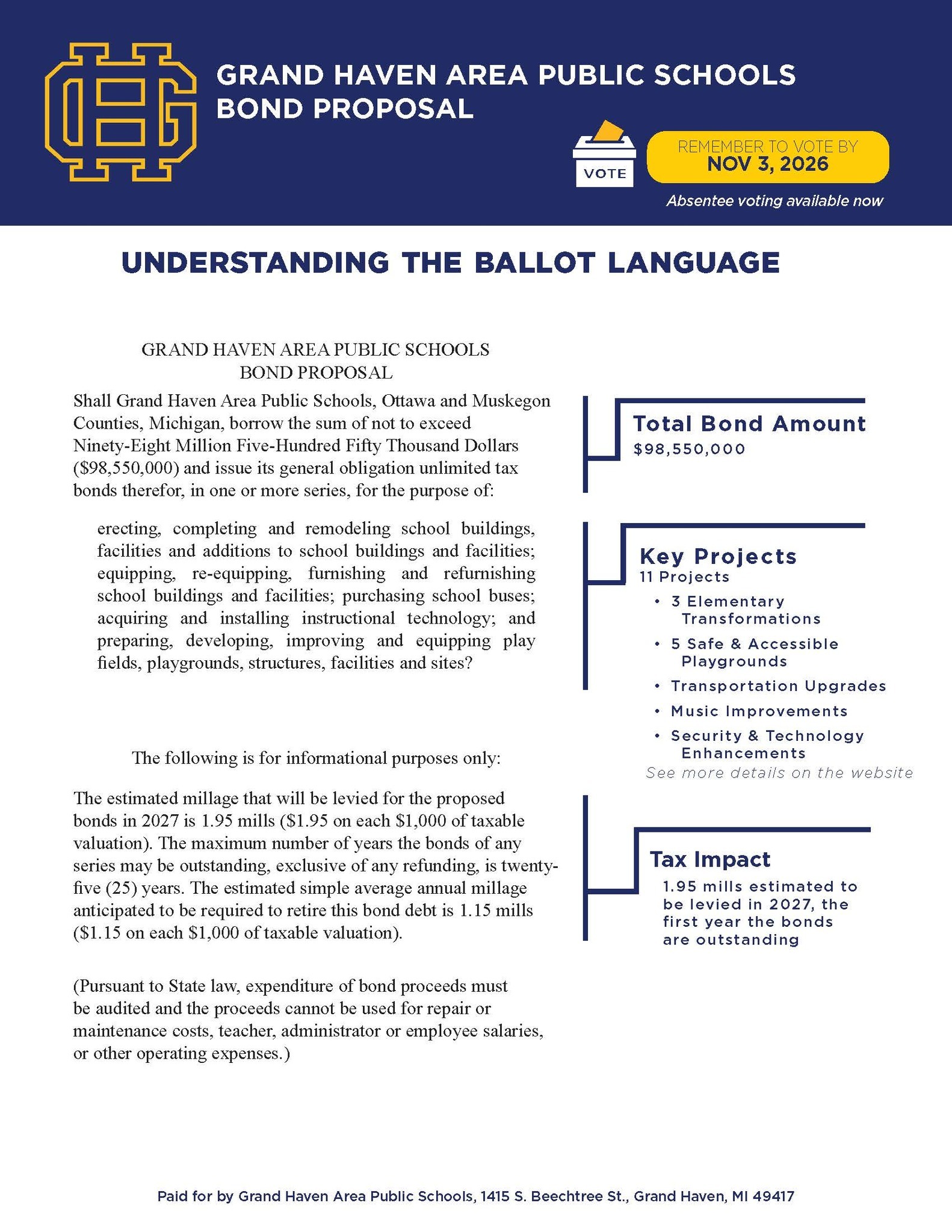
If approved, the proposed $98.55 million for projects would require an estimated initial debt levy of 1.95 mills in 2027. The total amount of bonded debt will not exceed $98.55 million, as stated in the ballot language.
The estimated initial debt levy in 2027 is 1.95 mills. The estimated simple average annual millage anticipated to retire the bond debt is 1.15 mills.
The ballot language states that the maximum number of years the bonds of any series may be outstanding is 25 years, excluding any refinancing.
See below for a breakdown of the ballot language:
Why doesn’t the ballot language list specific schools and projects?
The ballot uses broad categories because state law prescribes that general format. The district's specific commitments have been made publicly available:
- Board action: In July, the Board of Education formally adopted a specific list of projects the bond proposal is expected to fund.
- Ballot Considerations: there are practical limitations on the length of the Proposal question that is printed on the ballot.
- Independent Audit: Bond proceeds must be independently audited.
- Legal Limits: Bond proceeds cannot be used for repair, maintenance, or employee salaries.
- Public reporting: A project budget will be posted on the district website. Bond spending will be tracked on the district's existing website dashboard, so the community can follow every project.
Project Selection and Priorities
How was the bond proposal developed, and how did community input help shape it?
The proposed bond scope is the result of a thoughtful, multi-year planning process that began in 2024 and was designed to align the District's long-term vision with community priorities and documented facility needs.
Throughout the planning process, the District engaged staff, students, parents, community leaders, local municipalities, neighbors, business partners, senior citizens, and other stakeholders from every corner of our nearly 100-square-mile district through nearly 200 engagement opportunities.
This ongoing feedback helped shape both the District's long-term vision and priorities.
The process began with the development of the District's Strategic Plan, which established priorities for student learning, financial responsibility, and communication, transparency, and trust. Those priorities then guided the creation of the District's long-term Facilities Master Plan—a roadmap for how Grand Haven Area Public Schools can thoughtfully update its facilities over time to enhance teaching and learning, improve safety and security, enhance operational efficiency, and promote long-term sustainability.
The District also evaluated multiple facility scenarios, including larger, more comprehensive options. Those options were considered alongside facility condition data, enrollment trends, educational programming, implementation logistics, operational needs, financial impacts, and scientific survey research. While there was broad recognition that significant facility improvements are needed, the importance of balancing those needs with affordability emerged throughout the community engagement process.
The proposed bond represents a strategic first step toward implementing the District's long-term Facilities Master Plan, balancing documented facility needs, educational priorities, implementation logistics, operational efficiency, financial stewardship, and the priorities expressed by our community.
Survey results showed the strongest voter support for investments in buses, technology, and musical instruments, followed by renovations to the district's elementary schools. Community feedback also indicated a preference for renovations over new construction, along with concerns about taxes and economic uncertainty.
Why were Ferry, Peach Plains, and Rosy Mound selected for this bond proposal?
While GHAPS has identified significant facility needs across the district, addressing every need at once would require a significantly larger bond proposal and a greater tax impact on community members. Instead, the District developed a phased approach that balances facility improvements with responsible financial stewardship while maintaining a clear, long-term roadmap to address future projects.
Multiple factors were considered in determining which elementary schools were included in Phase I. The District balanced documented facility needs, current and future enrollment, educational programming, implementation logistics, operational efficiency, financial stewardship, community feedback, and scientific survey research.
Ferry, Peach Plains, and Rosy Mound were selected because improving these schools first best addresses current facility and enrollment needs while preparing for future attendance boundary adjustments associated with later phases of the Facilities Master Plan. Rosy Mound is already at or near capacity, Peach Plains is approaching capacity, and all three schools are expected to serve additional students as attendance boundaries are adjusted to support future phases of the Facilities Master Plan.
Why are buses and technology included in this proposal rather than purchased through the sinking fund?
There is a high need for funding to support a safer, more efficient, and reliable fleet. GHAPS has over 50 buses transporting students more than 1 million miles annually across nearly 100 square miles of our district.
The sinking fund approved in 2024 can fund projects including parking lots, boilers, roofs, student technology devices, buses, security upgrades, and emergency building repairs. Buses and major technology projects are not planned in the Sinking Fund. You can learn more about the planned sinking fund projects here.
The bond proposal would authorize approximately $3.5 million for districtwide technology and $1.33 million for bus replacements when existing assets have outlived their useful lifecycle.
Additionally, survey results and stakeholder input showed community members supported bond funding for buses, technology, and musical instruments.
Construction and Implementation
When would construction begin and end?
Based on current conceptual plans, construction projects for this bond proposal would begin in 2028 and end in 2032.
Maintaining safe, productive learning environments would remain a priority throughout construction.
Why is the district investing in school renovations rather than continuing with ongoing repairs?
GHAPS maintenance staff work hard every day to keep our buildings safe, clean, and operational. However, many building systems are reaching or have reached the end of their useful life.
At some point, continuing to patch older systems becomes less efficient than replacing them or renovating. Larger renovations can also improve safety, energy efficiency, accessibility, and learning environments for students and staff.
What oversight and accountability measures would be in place for bond projects?
If approved by voters, the district’s architect/engineer would design the proposed projects and prepare construction documents and specifications for the projects for review by the State.
Once the projects are designed, the district’s construction manager will assemble bid packages and publicly advertise to solicit competitive bids for all work. This is required by the State of Michigan Revised School Code and ensures that the district selects the lowest responsive and responsible bidder. All qualified contractors will have an opportunity to attend a pre-bid meeting to obtain additional information and project clarification. All qualified contractors will have the opportunity to participate in the competitive bid process.
Each project will be required to be submitted to both the Bureau of Construction Codes (BCC) and the Bureau of Fire Services (BFS) for both plan review and permitting. These agencies will review the projects to ensure they comply with applicable codes before any building permits are issued. Building plans and specifications must be signed and sealed by a licensed architect/professional engineer before submission. Michigan law requires school districts to consult on the plans for the construction or major renovation regarding school safety issues with the law enforcement agency that is the first responder for that school building. This consultation would happen after a bond proposal has been approved by voters, before construction documents are finalized prior to project commencement.
Our Long-Term Facilities Master Plan
How many phases are included in the Facilities Master Plan, what will they cost, and when will they occur?
The 2026 bond proposal is Phase 1 and a first step in its long-term Facilities Master Plan.
The timing of the strategies and proposed future projects in the Master Plan would be shaped by future Board decisions and, where applicable, voter-authorized funding.
No immediate changes are planned, and implementation would occur gradually over time. The pace and sequencing of work would depend on a variety of factors, including the scope and scale of any future bond proposals, available resources, and evolving district needs.
As this work moves forward, we will continue to communicate clearly and regularly with families, staff, and the community before making any changes.
Why not address all district needs at once?
Addressing every identified need at once would require a significantly larger bond authorization of hundreds of millions of dollars and much greater tax impact, which community members shared during surveys and stakeholder sessions they were not willing to support.
Phasing bond proposals and issuing authorized bonds in series allows construction to be structured to minimize disruption and makes projects more manageable from a construction and logistics standpoint, minimizing the disruptions to students and staff throughout the district.
What are the plans for the district property at Lincoln and 152nd?
The district continues to own the property at Lincoln/152nd. The facility master plan recommends retaining the property as a district asset for potential future use. There are currently no plans to develop the site.
School-Specific Questions
What are the long-term plans for Lake Hills and Robinson Elementary?
- The district’s long-term Facilities Master Plan includes these schools as additional elementary schools that would be upgraded in future phases of the master plan.
- No large-scale capital improvements are currently planned for other school buildings with this bond proposal.
- Other schools would not receive air conditioning in this current bond proposal, but this is planned to be addressed in future phases of the master plan.
Learn more about the master plan. The ultimate goal is to transform Robinson and Lake Hills similarly to how Ferry, Peach Plains, and Rosy Mound are proposed to be transformed.
What are the plans for Griffin Elementary, including its closure and future enrollment?
The district’s long-term Facilities Master Plan includes a future 5-8 campus on the current White Pines, Griffin, and Education Service Center properties. The timing of that project will depend on a future bond proposal and additional planning, so a final date for Griffin Elementary to close has not been determined.
The current plan is to phase out enrollment at Griffin gradually as students move on to fifth grade. Griffin would remain open during this first bond program, and the district has committed to keeping it open long enough for students currently enrolled there to complete fourth grade at Griffin.
The timing of future kindergarten enrollment at Griffin will depend largely on when additional classroom space will become available at the schools that would receive Griffin students. As those plans and timelines become clearer, the district will provide families with advance notice about any enrollment changes.
While projects in the Facilities Master Plan are interconnected and earlier phases prepare other schools to accommodate future attendance-boundary adjustments, work at White Pines/Lakeshore is currently scheduled as a future phase of the master plan.
Why isn't Lakeshore Middle School included in this bond proposal, and what are the plans for its future?
Voters did not approve previous bond proposals that included addressing Lakeshore Middle School. After those elections, intensive feedback sessions revealed the community at large was more supportive of solutions to the elementary schools first, before addressing Lakeshore Middle School.
Logistically, the future improvements at Lakeshore depend on earlier phases of the Facilities Master Plan. Those projects prepare other schools for future attendance-boundary adjustments, which are necessary for later phases to move forward.
Moving Lakeshore into Phase 1 would not necessarily accelerate the project and would require a significantly larger bond authorization, increase the tax impact, and extend the Phase 1 timeline.
In the meantime, Lakeshore will continue receiving necessary repairs and maintenance through the annual budget and voter-approved sinking fund.
Which district buildings are planned for closure, consolidation, or future reuse?
Griffin Elementary is planned to close as an elementary school; its site would become part of the grades 5–8 campus, as outlined in the long-term facilities master plan.
No closing date has been set. Griffin would remain open during this first bond program, and the district has committed to keeping it open long enough for students currently enrolled there to complete fourth grade at Griffin.
Lakeshore is planned for reuse, and the master plan also considers early childhood expansion. The concepts retain school sites rather than leave them vacant.
Paid for by Grand Haven Area Public Schools 1415 S. Beechtree St., Grand Haven, MI 49417 | 616-850-5000


